Image: <a href="//commons.wikimedia.org/w/index.php?title=User:MckissickMuseum&action=edit&redlink=1" class="new" title="User:MckissickMuseum (page does not exist)">University of South Carolina. McKissick Museum </a> (CC BY 4.0)
triclinicuncommonPhosphates
Turquoise
CuAl₆(PO₄)₄(OH)₈·4H₂O
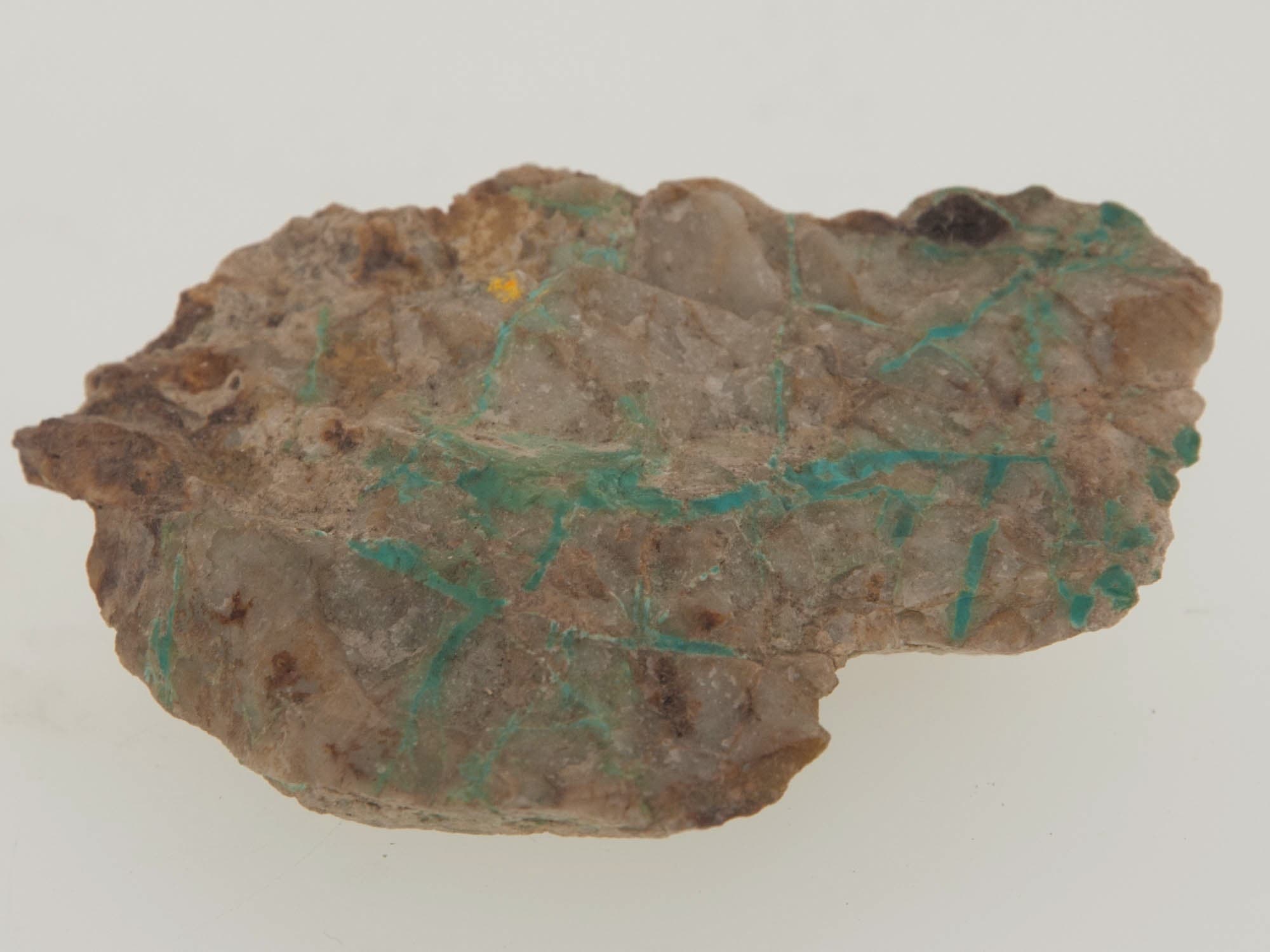
Thin veins of green-blue turquoise are visible within a matrix of massive milky quartz. The turquoise exhibits an opaque appearance with an earthy luster.
Turquoise Physical Properties
Mohs Hardness
5Crystal System
triclinicLuster
earthyStreak Color
white to pale blue-greenCleavage
good on {001}, poor on {100}Fracture
conchoidalSpecific Gravity
2.65Colors
green-blue, sky-blue, blue-green, apple-greenTransparency
opaqueType Locality
Iran (Persia), Sinai Peninsula, USA (Arizona, Nevada, New Mexico), ChinaMineral Group
PhosphatesUses
jewelry, ornamental stone, carving, collectorAssociated Minerals
quartz, limonite, chalcedonyRarity
uncommonGeological Context
Turquoise is a secondary mineral that forms in arid regions, typically in weathered aluminum-rich igneous or sedimentary rocks, where copper-bearing solutions react with phosphate and aluminum.


