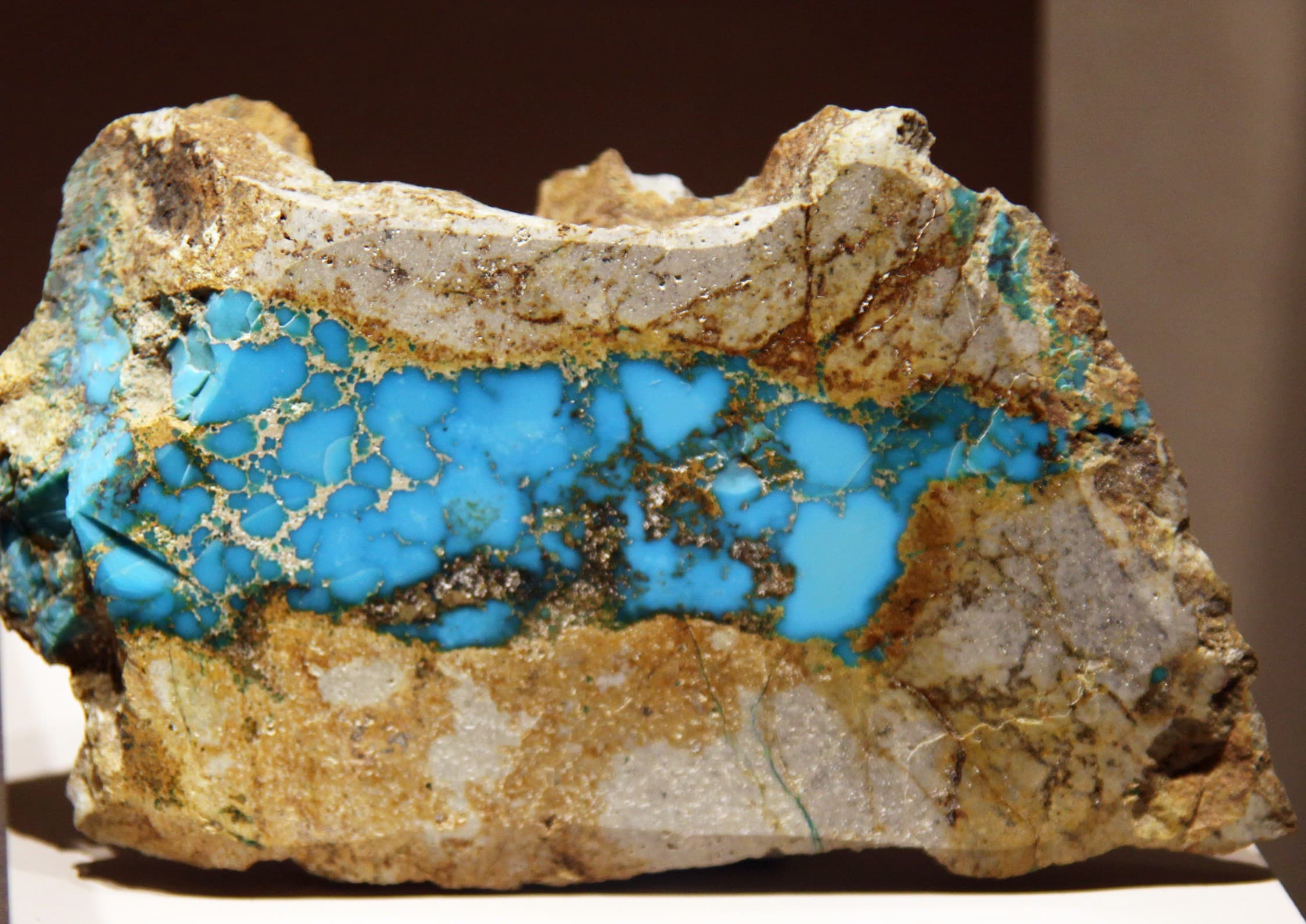
Image: <a rel="nofollow" class="external text" href="https://www.flickr.com/people/23165290@N00">Tim Evanson</a> from Washington, D.C., United States of America (CC BY-SA 2.0)
triclinicuncommonPhosphates
Turquoise
CuAl6(PO4)4(OH)8·4H2O
This specimen exhibits a striking blue-green color, characteristic of high-quality turquoise, with a smooth, waxy appearance. It appears to be a solid mass, possibly with some darker matrix material adhering to it.
Turquoise Physical Properties
Mohs Hardness
5.5Crystal System
triclinicLuster
waxyStreak Color
white to pale bluish-greenCleavage
perfect on {001}, good on {010}, but rarely observed due to cryptocrystalline natureFracture
conchoidal to unevenSpecific Gravity
2.7Colors
sky blue, blue-green, apple green, greenish-grayTransparency
opaqueType Locality
Cerrillos, New Mexico, USAMineral Group
PhosphatesUses
jewelry, ornamental stone, collectorAssociated Minerals
kaolinite, limonite, chalcedony, quartz, sericiteRarity
uncommonGeological Context
Turquoise is a secondary mineral formed in arid climates by the alteration of aluminum-rich rocks, often in association with copper deposits. It precipitates from circulating phosphate-rich waters interacting with aluminum and copper minerals.