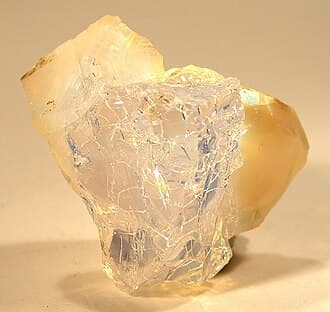
Afghanite
Image: Raimond Spekking (CC BY-SA 4.0)
Mineral NameAfghanite
Chemical Formula(Na,K)₂₂Ca₁₀(Si₂O₆)₆(SO₄)₆Cl₆·H₂O
Mohs Hardness5.5
Crystal Systemhexagonal
Lustervitreous
Streak Colorwhite
Cleavageimperfect on {1010}
Fractureconchoidal
Specific Gravity2.6
Colorsblue, colorless, white, gray, green
Transparencytransparent
Type LocalitySar-e-Sang, Badakhshan Province, Afghanistan (type locality); Gjaidtroghöhe, Großes Fließtal, Austria (specimen locality)
Mineral GroupSilicates (Feldspathoid, Cancrinite group)
Usescollector, gemstone (rarely)
Associated Mineralspyrite, lazurite, diopside, calcite, dolomite
Rarityrare
Description
This specimen features deep blue Afghanite crystals, likely intergrown or massive, contrasting with metallic yellow Pyrite. The Afghanite exhibits a vibrant blue hue typical of the mineral.
Geological Context
Afghanite typically forms in contact metamorphic rocks, particularly in calc-silicate skarns or marbles, often associated with lazurite deposits. It is a product of metasomatic alteration.