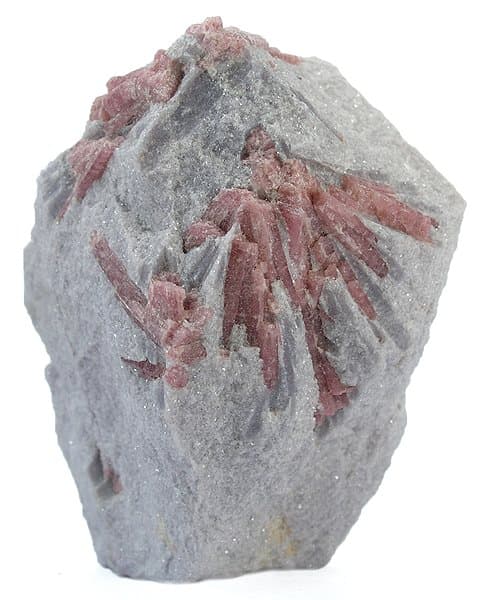
Tourmaline (Rubellite) and Lepidolite
Image: Robert M. Lavinsky (CC BY-SA 3.0)
Mineral NameTourmaline (Rubellite) and Lepidolite
Chemical FormulaTourmaline (Elbaite): Na(Li,Al)3Al6(Si6O18)(BO3)3(OH)4; Lepidolite: K(Li,Al)3(Si,Al)4O10(F,OH)2
Mohs HardnessTourmaline: 7-7.5; Lepidolite: 2.5-4
Streak ColorWhite
CleavageTourmaline: Indistinct; Lepidolite: Perfect basal
FractureTourmaline: Conchoidal to uneven; Lepidolite: Uneven
Specific GravityTourmaline: 3.0-3.26; Lepidolite: 2.8-2.9
Colorspink, red, lilac, grey
TransparencyTransparent to translucent
Type LocalityStewart Mine, Pala District, San Diego County, California
Mineral GroupSilicates (Cyclosilicate for Tourmaline, Phyllosilicate for Lepidolite)
Usesjewelry, collector, lithium source
Associated Mineralsquartz, feldspar, spodumene
Description
This specimen features radiating clusters of pink to reddish-pink prismatic tourmaline (rubellite) crystals embedded within a fine-grained, light grey to lilac-grey lepidolite matrix.
Geological Context
Both tourmaline and lepidolite are characteristic minerals of lithium-rich granitic pegmatites, forming from late-stage hydrothermal fluids during the cooling of igneous intrusions.


