Image: <bdi><a href="https://www.wikidata.org/wiki/Q56247090" class="extiw" title="d:Q56247090"><span title="mineral collector and dealer">Robert M. Lavinsky</span></a></bdi> (CC BY-SA 3.0)
triclinicuncommonphosphates
Turquoise
CuAl₆(PO₄)₄(OH)₈·4H₂O
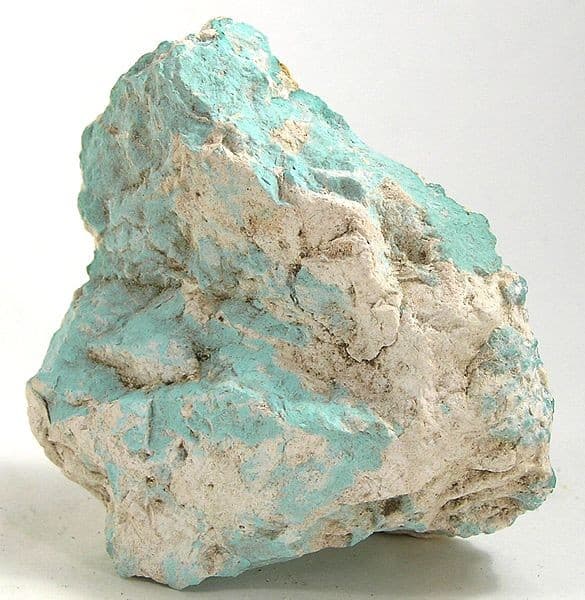
This specimen displays a vibrant blue-green color, characteristic of high-quality turquoise, with a waxy to dull luster. It appears as a massive, opaque formation, possibly botryoidal or nodular.
Turquoise Physical Properties
Mohs Hardness
5.5Crystal System
triclinicLuster
waxyStreak Color
white to pale blue/greenCleavage
good on {001}, poor on {010} (rarely observed due to massive habit)Fracture
conchoidal to unevenSpecific Gravity
2.75Colors
blue, blue-green, greenTransparency
opaqueType Locality
Mohave County, Arizona, USAMineral Group
phosphatesUses
jewelry, ornamental stone, carving materialAssociated Minerals
limonite, chalcedony, quartz, kaolinite, sericiteRarity
uncommonGeological Context
Turquoise is a secondary mineral that forms in arid regions, typically in altered aluminum-rich igneous or sedimentary rocks. It precipitates from groundwater solutions in fractures and cavities, often associated with copper deposits.


