Idocrase (Vesuvianite)
Image: Robert M. Lavinsky (CC BY-SA 3.0)
Mineral NameIdocrase (Vesuvianite)
Chemical FormulaCa₁₀(Mg,Fe)₂(Al,Fe)₄(SiO₄)₅(Si₂O₇)₂(OH,F,O)₄
Mohs Hardness6.5
Crystal Systemtetragonal
Lustervitreous
Streak Colorwhite
Cleavagepoor on {110} and {100}
Fractureconchoidal to uneven
Specific Gravity3.35
Colorsyellowish-green, olive-green
Transparencytransparent to translucent
Type LocalityJeffrey mine (Jeffrey quarry; Johns-Manville mine), Asbestos, Les Sources RCM, Estrie, Québec, Canada
Mineral GroupSilicates
Usesjewelry, collector
Associated Mineralsgarnet, diopside, epidote, wollastonite, calcite
Rarityuncommon
Description
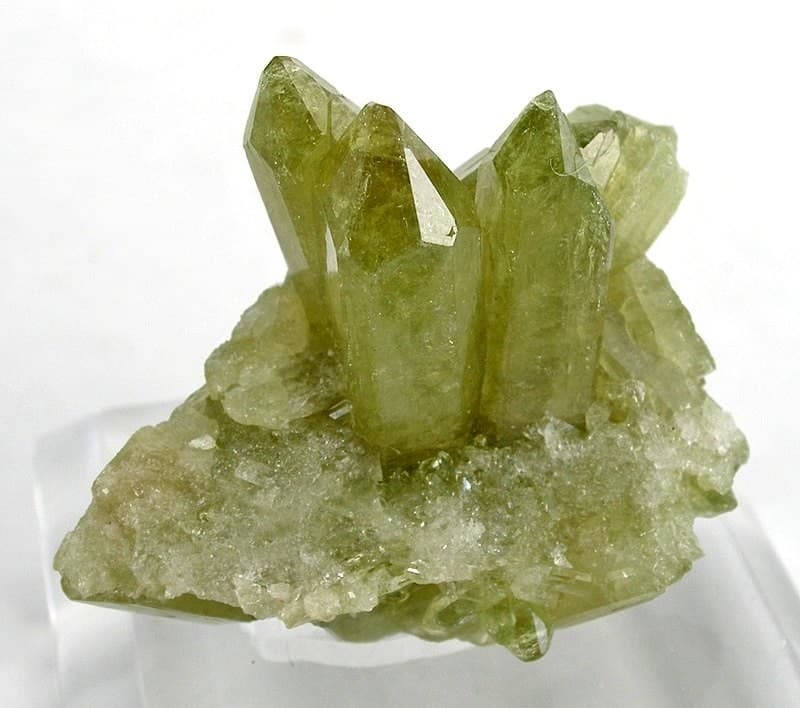
This specimen showcases several well-formed, prismatic, yellowish-green to olive-green Vesuvianite crystals with distinct pyramidal terminations, growing on a matrix of smaller, granular Vesuvianite. The crystals exhibit a bright vitreous luster.
Geological Context
Vesuvianite typically forms in contact metamorphic limestones (skarns), altered basic igneous rocks, and serpentinites, often in association with other calcium-rich silicates.