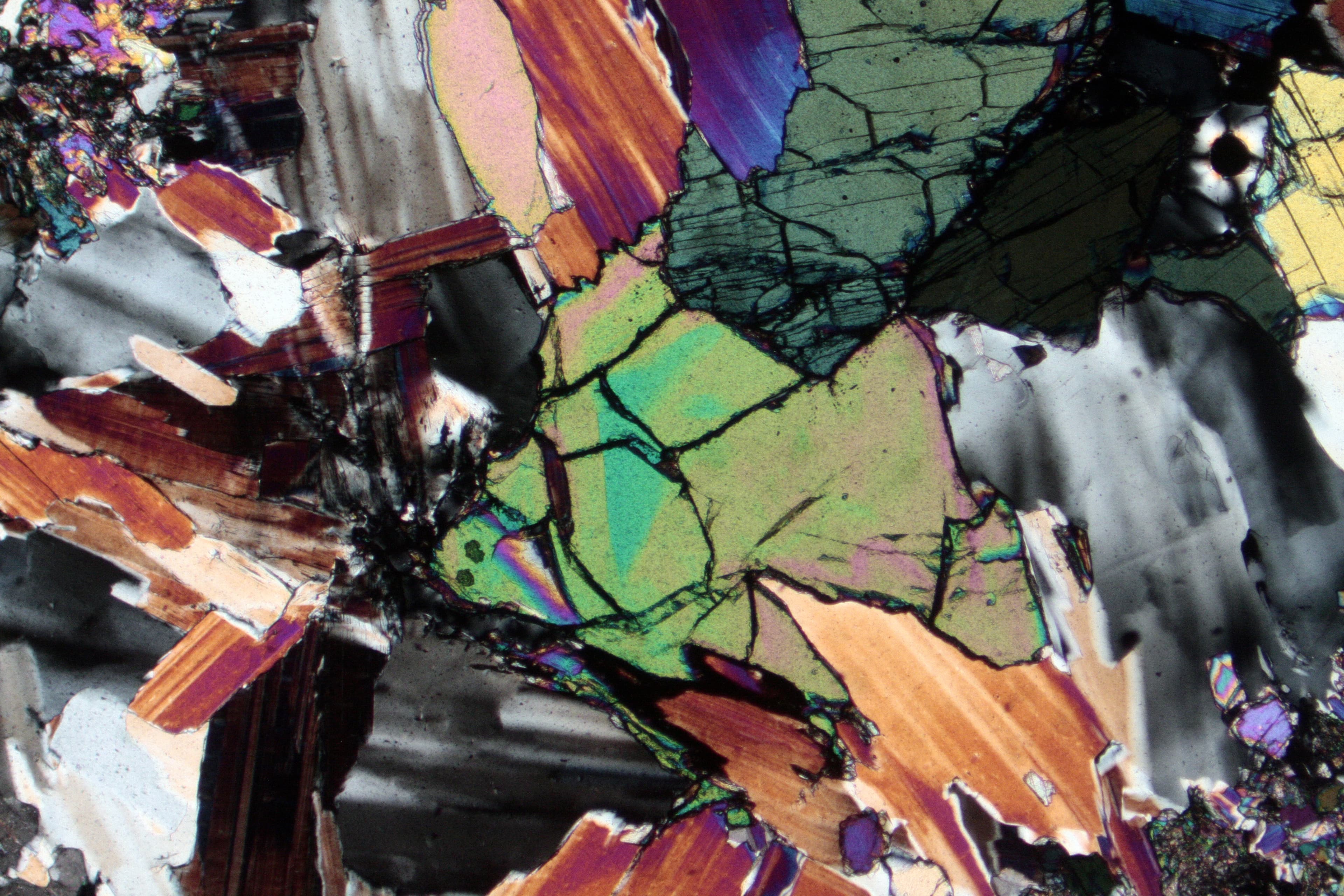
Epidote
Image: Strekeisen (CC BY-SA 4.0)
Mineral NameEpidote
Chemical FormulaCa2(Al,Fe)3(SiO4)3(OH)
Mohs Hardness6.5
Crystal Systemmonoclinic
Lustervitreous
Streak Colorwhite to grayish white
Cleavageperfect on {001}, good on {100}
Fractureuneven to conchoidal
Specific Gravity3.4
Colorspistachio green, yellowish green, brownish green, blackish green, brown, gray
Transparencytransparent to translucent
Type LocalityWorldwide, notable localities include Knappenwand (Austria) and Prince of Wales Island (Alaska, USA).
Mineral GroupSorosilicate (Epidote Group)
Usescollector's specimens, minor gemstone, indicator mineral in metamorphic rocks
Associated Mineralsmuscovite, quartz, feldspar, amphibole, garnet, chlorite
Raritycommon
Description
This photomicrograph, taken under crossed nicols, shows a large, fractured epidote crystal displaying vibrant green and blue high-order interference colors, surrounded by elongated muscovite crystals exhibiting pink, orange, and purple interference colors.
Geological Context
Epidote is a common rock-forming mineral found in regionally metamorphosed rocks (greenschist to amphibolite facies), contact metamorphic rocks, and hydrothermally altered igneous rocks, often indicating low-to-medium grade metamorphism.


