Slate
Image: “Jon Zander (Digon3)” (CC BY-SA 3.0)
Mineral NameSlate
Chemical FormulaComplex silicate, primarily hydrous aluminum silicates (clays) and SiO2 (quartz)
Mohs Hardness2.5
Streak ColorGray to black
CleavagePerfect slaty cleavage (foliation)
FractureSplintery to uneven, perpendicular to cleavage
Specific Gravity2.7
Colorsdark gray, greenish-gray, purplish-gray, black
TransparencyOpaque
Type LocalityWorldwide (e.g., Wales, Vermont, Pennsylvania, Brazil)
Mineral GroupMetamorphic rock
Usesroofing, flooring, blackboards, decorative stone, landscaping
Associated Mineralsquartz, muscovite, illite, chlorite, pyrite, hematite
Raritycommon
Description
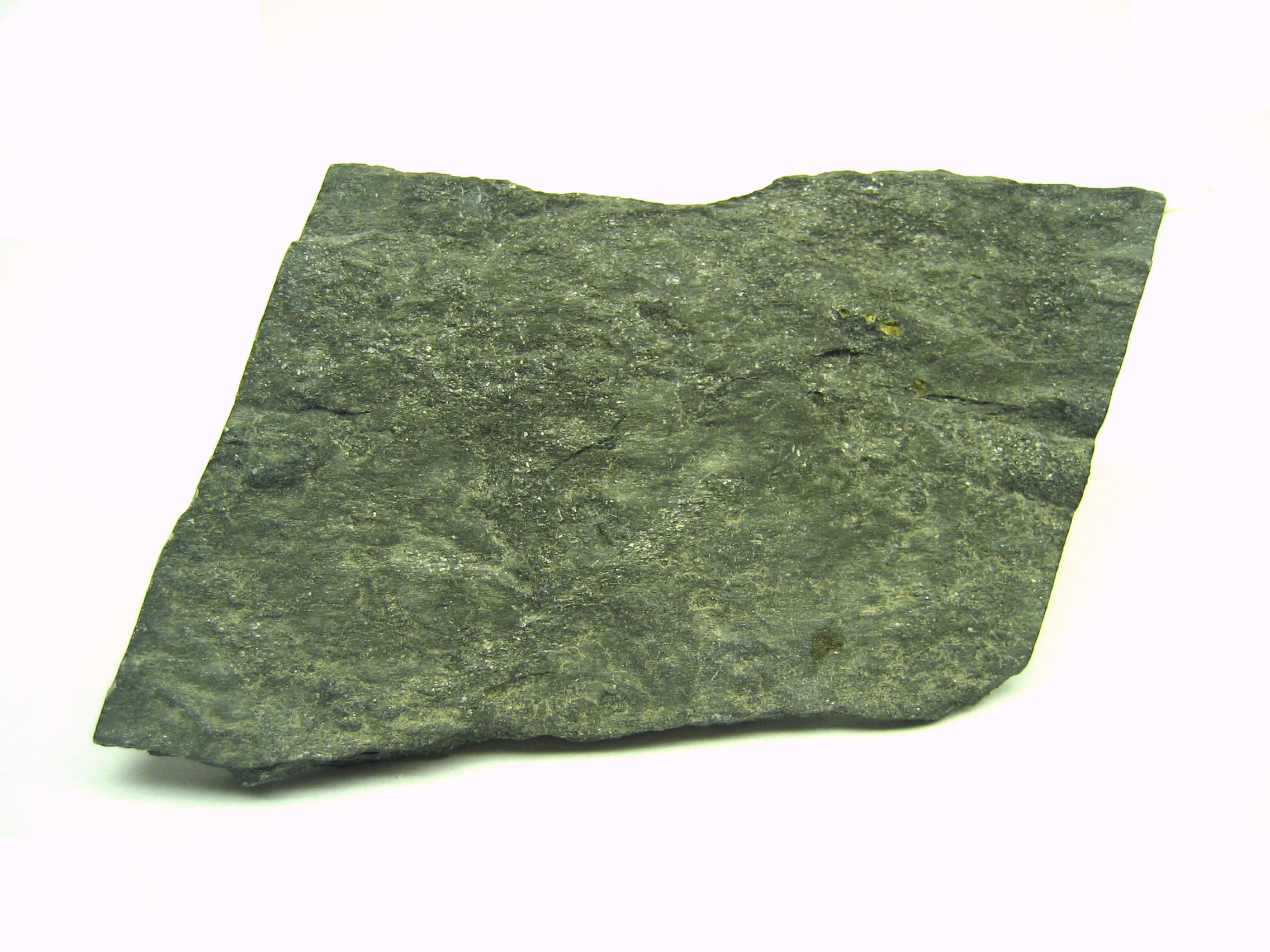
A dark greenish-gray, fine-grained metamorphic rock, presented as a flat, angular piece. Its surface shows a slightly textured, dull finish with some subtle reflective specks.
Geological Context
Slate is a low-grade metamorphic rock formed from the regional metamorphism of shale or mudstone. It typically forms in convergent plate boundaries where sedimentary rocks are subjected to directed pressure and moderate temperatures, resulting in its characteristic slaty cleavage.