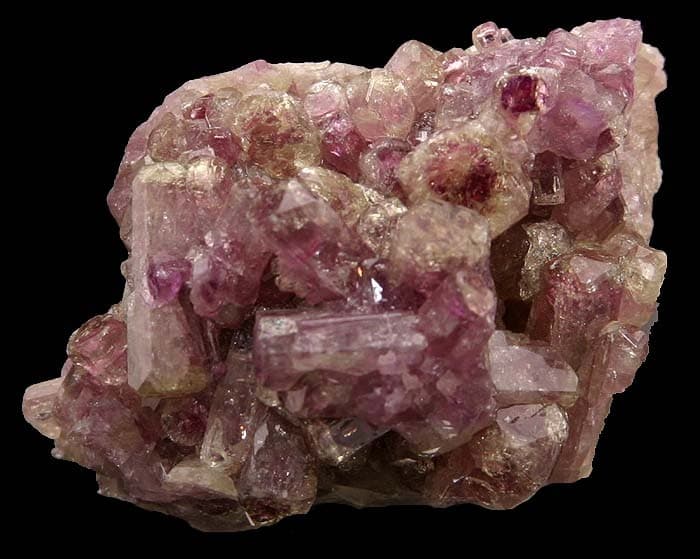
Idocrase (Vesuvianite)
Image: Robert M. Lavinsky (CC BY-SA 3.0)
Mineral NameIdocrase (Vesuvianite)
Chemical FormulaCa₁₀(Mg,Fe)₂Al₄(SiO₄)₅(Si₂O₇)₂(OH)₄
Mohs Hardness6.5
Crystal Systemtetragonal
Lustervitreous
Streak Colorwhite
Cleavagepoor on {110} and {100}
Fractureconchoidal to uneven
Specific Gravity3.35
Colorspink, purple, green, brown, yellow
Transparencytransparent to translucent
Type LocalityJeffrey mine (Jeffrey quarry; Johns-Manville mine), Asbestos, Les Sources RCM, Estrie, Québec, Canada
Mineral GroupSilicates
Usesjewelry, collector
Associated Mineralsgarnet, diopside, wollastonite, epidote, calcite
Rarityuncommon
Description
This specimen features a vibrant cluster of well-formed, prismatic to tabular Idocrase (Vesuvianite) crystals, predominantly in shades of pink and purple, with some areas appearing more translucent.
Geological Context
Vesuvianite typically forms in contact metamorphic limestones (skarns), altered basic igneous rocks, and serpentinites, often in areas where calcium-rich rocks have been subjected to high temperatures and pressures.


