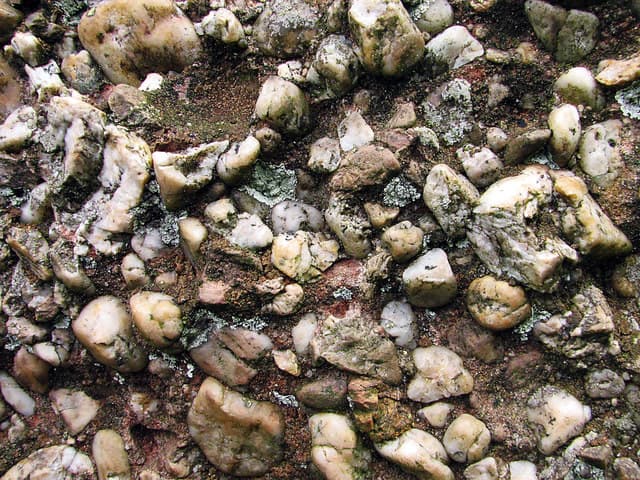
Conglomerate
Image: Roy Parkhouse (CC BY-SA 2.0)
Mineral NameConglomerate
Chemical FormulaComposed of various mineral and rock fragments (clasts) cemented together, commonly quartz, feldspar, chert, and other resistant rocks, with a matrix of sand, silt, and clay, and a cement of silica, calcite, or iron oxides.
Mohs Hardness3
Streak ColorVaries depending on matrix and clasts; often light brown, grey, or white.
CleavageN/A (clastic sedimentary rock; individual mineral clasts may exhibit cleavage but the rock as a whole does not)
FractureUneven to conchoidal (if clasts are quartz-rich and break across clasts), or irregular (if breaking around clasts).
Specific Gravity2.65
Colorswhite, beige, brown, reddish-brown, grey, greenish
TransparencyOpaque
Type LocalityHarold's Stones, United Kingdom (specifically referred to as Puddingstone)
Mineral GroupSedimentary rock (clastic)
Usesconstruction aggregate, building stone, decorative stone, landscaping
Associated Mineralsquartz, feldspar, chert, calcite, iron oxides, various rock fragments
Raritycommon
Description
A close-up view of a conglomerate rock, showing numerous rounded to sub-rounded clasts of varying sizes, predominantly light-colored (white, beige, grey), embedded in a darker, reddish-brown fine-grained matrix. Some clasts and matrix show patches of greenish lichen.
Geological Context
Conglomerates are clastic sedimentary rocks formed from the lithification of gravel, typically deposited in high-energy environments such as river channels, beaches, or glacial outwash plains, where clasts are rounded by abrasion before cementation.


