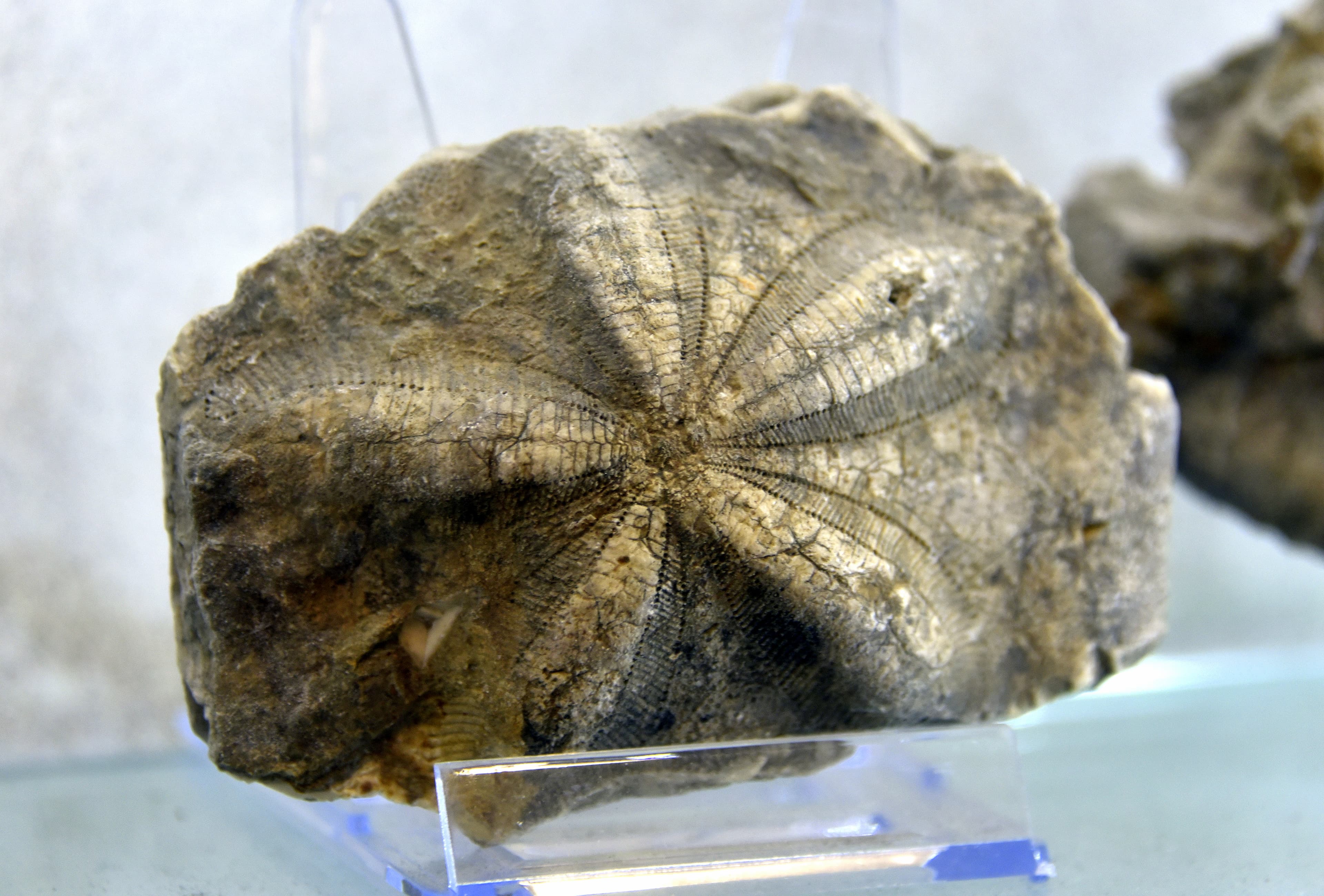
Starfish Fossil
Image: Osama Shukir Muhammed Amin FRCP(Glasg) (CC BY-SA 4.0)
Mineral NameStarfish Fossil
Chemical FormulaPrimarily CaCO3 (original skeleton), often replaced by calcite (CaCO3) or silica (SiO2) during fossilization.
Mohs Hardness3
Streak ColorWhite to light brown/grey
CleavageN/A (biological structure); if replaced by calcite, perfect rhombohedral.
FractureUneven to conchoidal
Specific Gravity2.65
Colorsbrown, grey, tan
TransparencyOpaque
Type LocalityErbil Stones & Gems Museum, Erbil Citadel, Hawler, Iraq (display locality)
Mineral GroupFossils are not minerals; they are preserved remains of organisms. The original organism's skeleton was biogenic calcium carbonate. The fossil itself is typically composed of carbonates or silicates, forming a sedimentary rock.
Usesscientific study, education, collector specimens, museum display
Associated Mineralscalcite, quartz, clay minerals, limestone, sandstone
Rarityuncommon
Description
This specimen displays a well-preserved fossilized starfish, exhibiting its characteristic five-fold radial symmetry and intricate skeletal details, embedded within a light brown to grey sedimentary rock matrix.
Geological Context
Starfish fossils form when the remains of a starfish are rapidly buried in sediment, preventing decomposition. Over geological time, the organic material is replaced by minerals like calcite or silica, preserving the original structure within sedimentary rocks such as limestone or shale, often found in ancient marine environments.


