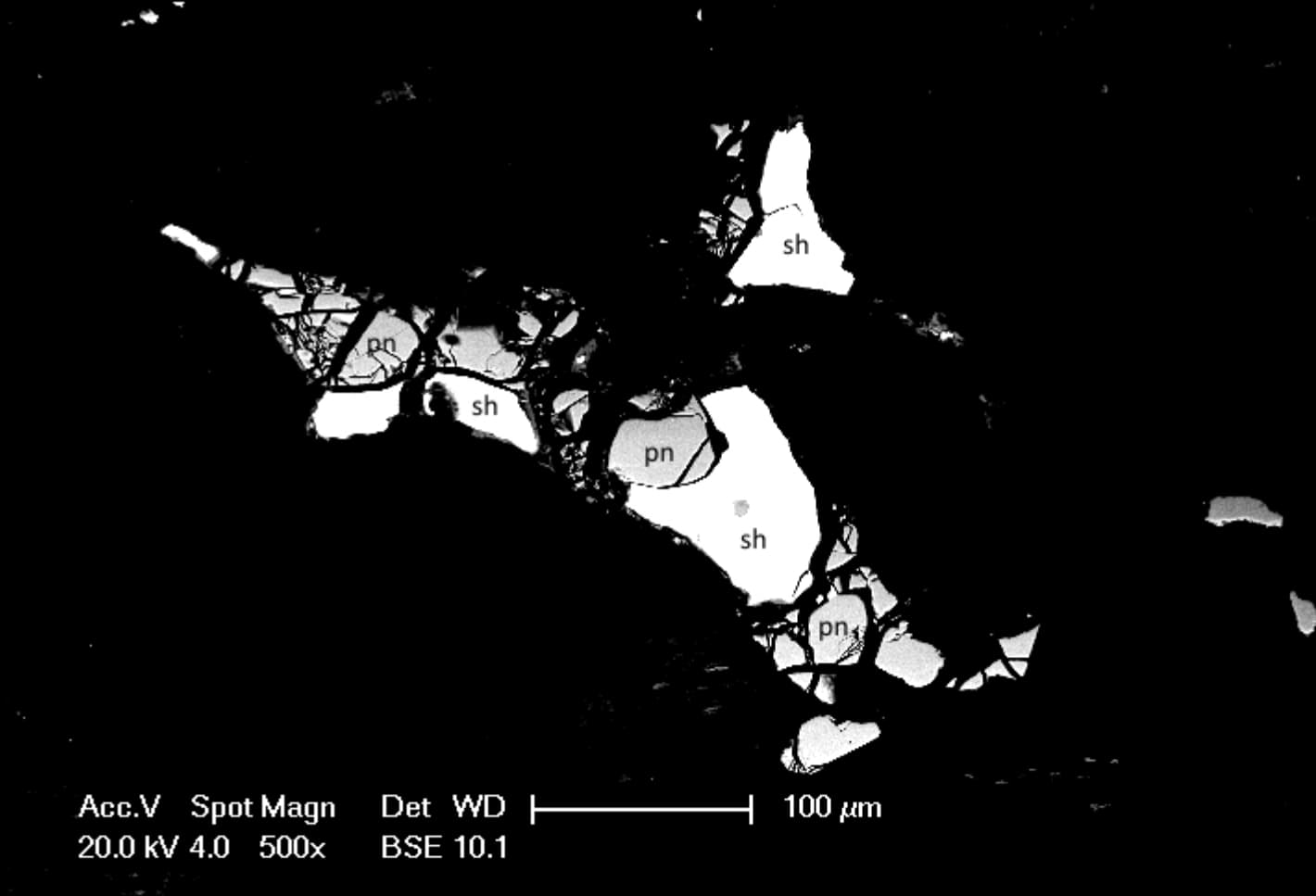
Shandite, Pentlandite, and Lizardite
Image: Ben Grguric (Public domain)
Mineral NameShandite, Pentlandite, and Lizardite
Chemical FormulaShandite: Ni₃Pb₂S₂; Pentlandite: (Fe,Ni)₉S₈; Lizardite: Mg₃(Si₂O₅)(OH)₄
Mohs Hardness2.5 - 4
Streak ColorBlack to bronze-brown (sulfides), White (silicate)
CleavageAbsent to poor (sulfides), Perfect on {001} (Lizardite)
FractureConchoidal to uneven
Specific Gravity2.5 - 7.25
Colorsbronze-yellow, yellowish-white, green, white, grey
TransparencyOpaque (sulfides), Translucent to opaque (Lizardite)
Type LocalityNickel Reward Mine, Trial Harbour district, West Coast municipality, Tasmania, Australia
Mineral GroupSulfides (Shandite, Pentlandite), Silicates (Lizardite)
Usesnickel ore, industrial (Lizardite), scientific interest, collector
Associated Mineralspyrrhotite, chalcopyrite, magnetite, other serpentine minerals
Description
This backscattered electron (BSE) SEM image displays an intergrowth of bright white Shandite (sh) and greyish Pentlandite (pn) grains, embedded within a darker matrix, which is identified as Lizardite.
Geological Context
This mineral assemblage is characteristic of serpentinized ultramafic rocks, where nickel-iron sulfides like Pentlandite and rare lead-nickel sulfides like Shandite are found within a matrix of serpentine minerals such as Lizardite, formed through hydrothermal alteration.


