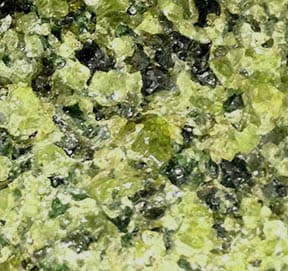
Peridotite
Image: Andrea R Bair (CC BY-SA 4.0)
Mineral NamePeridotite
Chemical FormulaRock, primarily (Mg,Fe)2SiO4 (olivine) and (Mg,Fe)SiO3 (pyroxene)
Mohs Hardness5
Streak ColorWhite to pale green
CleavagePoor to indistinct (olivine), good in two directions (pyroxene)
FractureUneven to conchoidal
Specific Gravity3.2
Colorsdark green, yellow-green, black
TransparencyOpaque
Type LocalityWorldwide, common in ophiolite complexes (e.g., Oman, Cyprus), mantle xenoliths in volcanic rocks, and deep-seated intrusions
Mineral GroupUltramafic igneous rock (composed mainly of silicate minerals)
Usessource of chromium, nickel, and platinum group metals, building stone, decorative stone (when serpentinized)
Associated Mineralsolivine, orthopyroxene, clinopyroxene, chromite, magnetite, garnet (in some varieties)
Description
This image shows a closeup of peridotite, a coarse-grained ultramafic igneous rock, characterized by its granular texture with prominent yellowish-green olivine crystals intermixed with darker, often black or very dark green pyroxene and other accessory minerals.
Geological Context
Peridotite is the dominant rock type of the Earth's upper mantle. It forms by crystallization from high-temperature, silica-poor magmas or as a residual rock after partial melting of the mantle, and is brought to the surface in ophiolite complexes, kimberlite pipes, and as xenoliths in volcanic eruptions.


