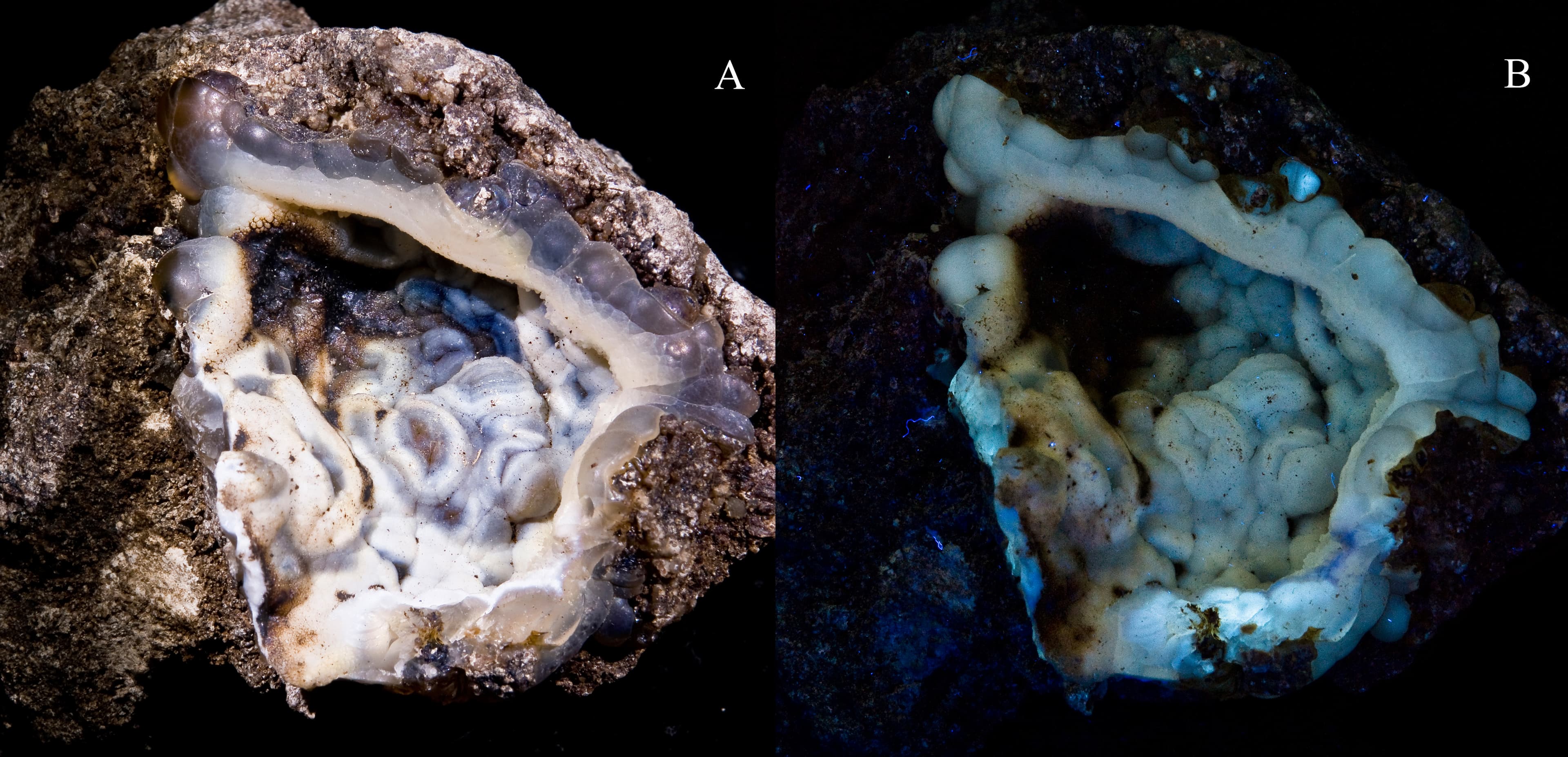
Opal-CT (Lussatite)
Image: Didier Descouens (CC BY-SA 4.0)
Mineral NameOpal-CT (Lussatite)
Chemical FormulaSiO₂·nH₂O
Mohs Hardness5.5
Crystal Systemamorphous
Streak Colorwhite
Cleavagenone
Fractureconchoidal
Specific Gravity2.1
Colorswhite, translucent, grayish-blue, fluorescent blue (under UV)
Transparencytranslucent
Type LocalityMine des Rois, Dallet, Pont-du-Château, Puy-de-Dôme, Auvergne, France
Mineral GroupSilicates (mineraloid)
Usescollector's item, scientific study
Associated Mineralsvolcanic rock matrix, chalcedony, other silica minerals
Rarityuncommon
Description
This specimen features a botryoidal to mammillary formation of translucent to white opal-CT, filling a cavity within a dark, rough matrix. Under ultraviolet light, the opal-CT exhibits a striking light blue fluorescence.
Geological Context
Opal-CT typically forms in low-temperature hydrothermal environments or by the alteration of volcanic ash, often found filling vugs and fractures in volcanic rocks. It represents an intermediate stage between amorphous opal-A and more crystalline silica phases like chalcedony.


