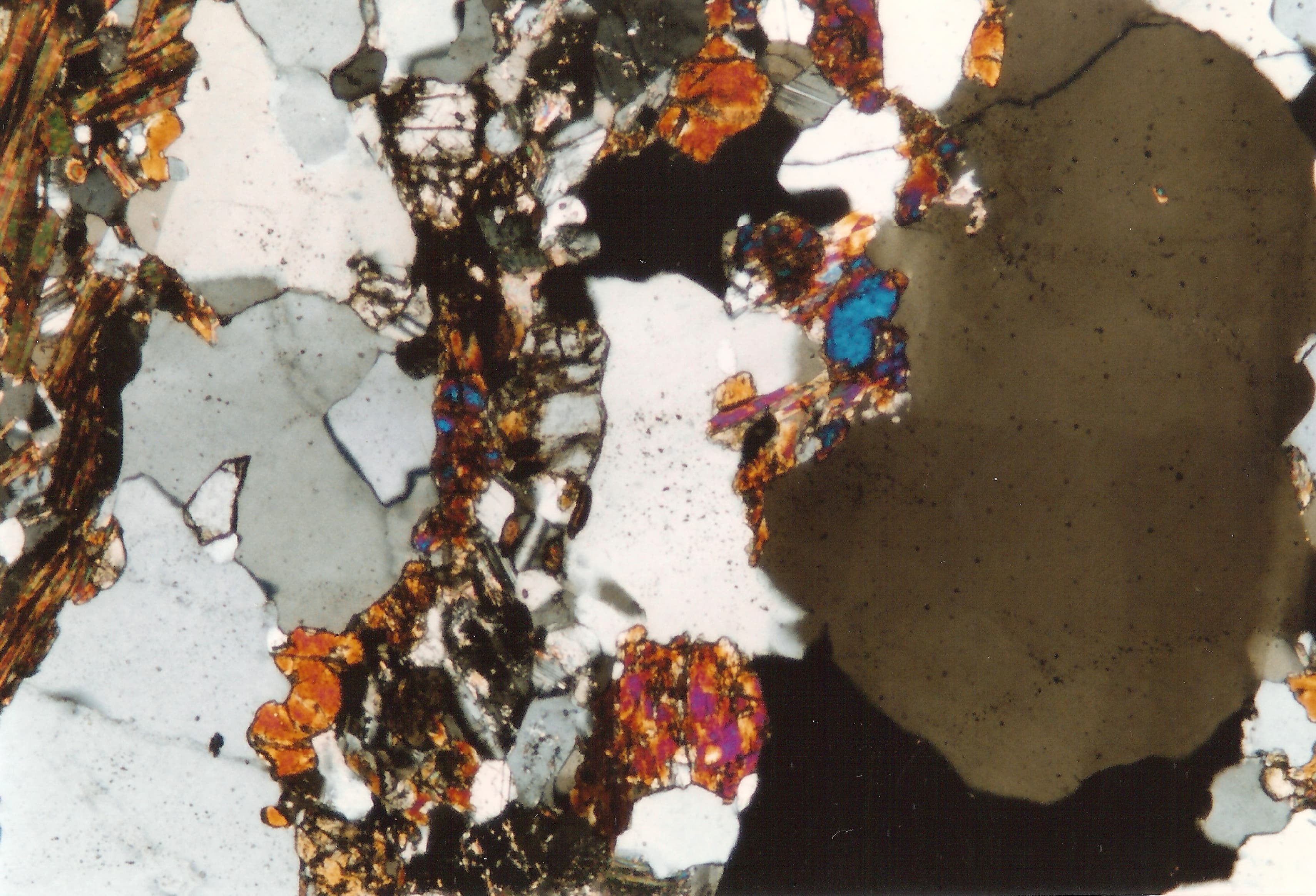
Granite
Image: Leo-setä (CC BY 2.0)
Mineral NameGranite
Chemical FormulaSiO2 (Quartz), KAlSi3O8 (Orthoclase), (Na,Ca)(Al,Si)AlSi2O8 (Plagioclase), K(Mg,Fe)3AlSi3O10(OH)2 (Biotite)
Mohs Hardness6.0-7.0
Streak ColorWhite to Grey
CleavageVariable; Quartz (none), Feldspar (good in 2 directions), Biotite (perfect in 1 direction)
FractureConchoidal (Quartz), Uneven (Feldspar, Biotite)
Specific Gravity2.65
Colorswhite, grey, pink, red, black
TransparencyTransparent (minerals in thin section), Opaque (bulk rock)
Type LocalityWorldwide
Mineral GroupSilicates (dominant minerals)
Usesconstruction material, decorative stone, dimension stone, aggregate
Associated Mineralsquartz, feldspar, biotite, muscovite, amphibole, zircon, apatite, magnetite
Raritycommon
Description
This microscopic image, taken under polarized light, reveals an interlocking texture of various mineral grains within a rock microsection. Prominent are large anhedral grains displaying low interference colors (likely quartz and feldspar), alongside smaller, higher birefringence minerals exhibiting vibrant blues, purples, oranges, and reds (potentially biotite, amphibole, or other accessory minerals).
Geological Context
Granite is an intrusive igneous rock that forms from the slow crystallization of magma rich in silica and alkali feldspar deep beneath the Earth's surface, typically in continental crust settings.


