Garnet Micaschist
Image: Strekeisen (CC BY-SA 4.0)
Mineral NameGarnet Micaschist
Chemical FormulaMuscovite: KAl₂(AlSi₃O₁₀)(OH)₂; Garnet: X₃Y₂(SiO₄)₃ (where X=Mg, Fe, Mn, Ca; Y=Al, Fe, Cr)
Mohs Hardness2.0-7.5 (variable, depending on mineral composition; muscovite 2-2.5, garnet 6.5-7.5)
Streak ColorWhite to light grey
CleavageExcellent basal cleavage (muscovite), none (garnet)
FractureUneven, splintery
Specific Gravity2.7-3.0
Colorssilvery-grey, green, brown, black, yellow, pink, purple, blue
TransparencyOpaque (in hand sample), transparent (in thin section)
Type LocalityNot specified in metadata
Mineral GroupMetamorphic Rock (composed primarily of Silicates)
Usesbuilding stone, aggregate, decorative stone, geological research
Associated Mineralsmuscovite, garnet, quartz, biotite, feldspar, staurolite, kyanite
Raritycommon
Description
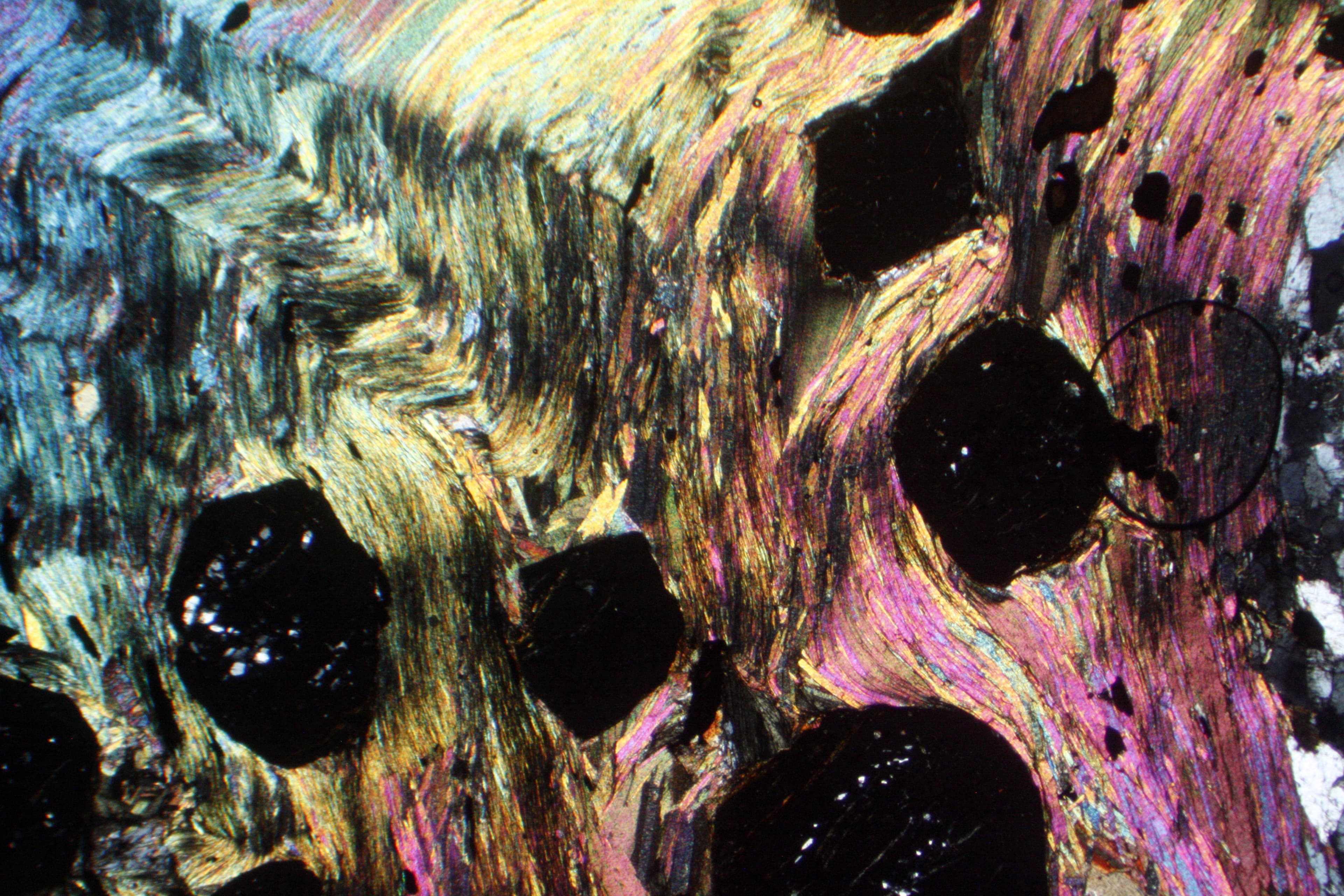
A microscopic image of a garnet micaschist thin section under crossed nicols, showing large, black, isotropic garnet porphyroblasts embedded within a matrix of brightly colored, wavy muscovite crystals exhibiting high interference colors.
Geological Context
Micaschists are medium- to high-grade metamorphic rocks formed from the regional metamorphism of pelitic (clay-rich) sediments. They are characterized by a strong schistosity, a planar fabric resulting from the alignment of platy mica minerals, and often contain porphyroblasts of minerals like garnet.