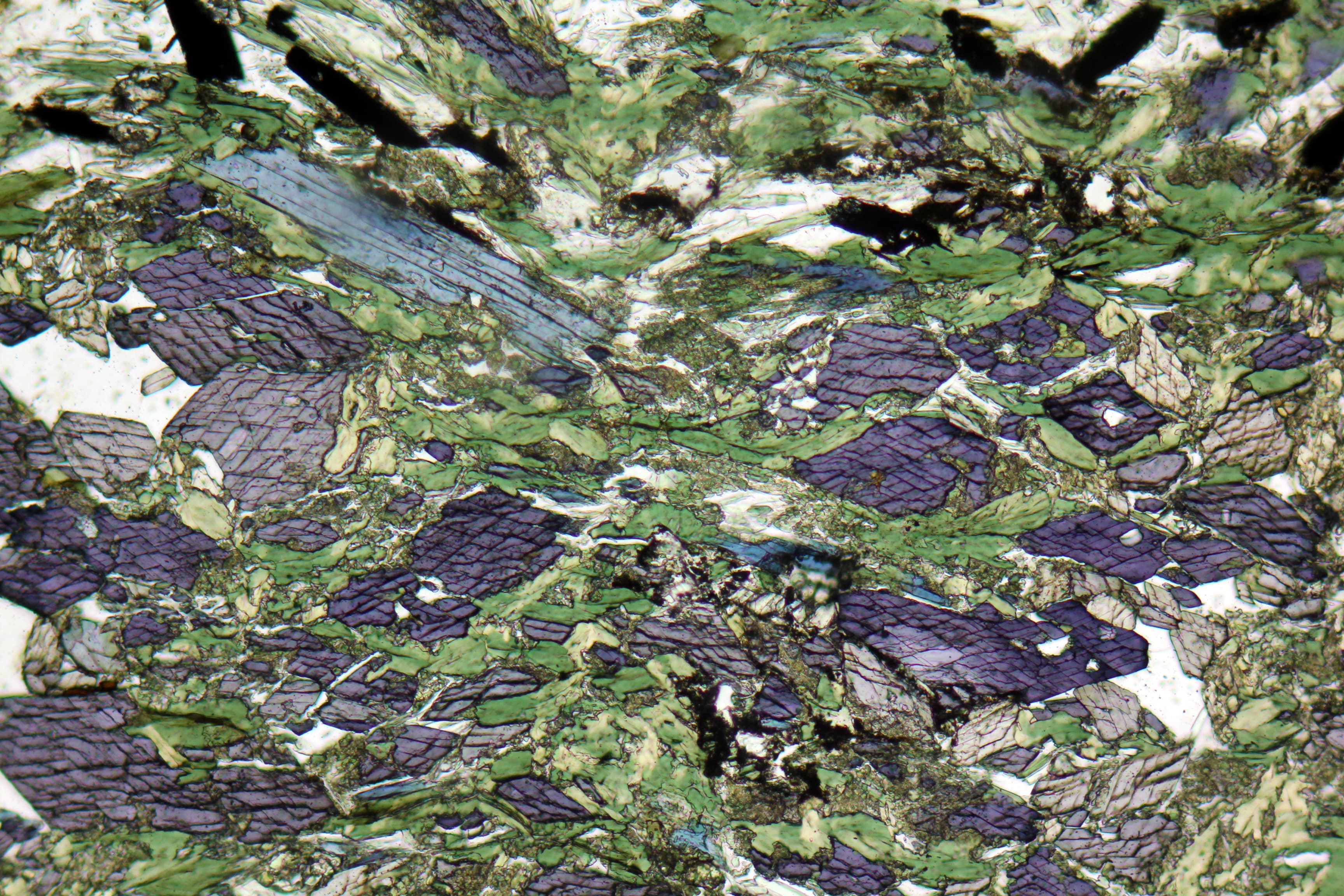
Blueschist
Image: Strekeisen (CC BY-SA 4.0)
Mineral NameBlueschist
Chemical FormulaA metamorphic rock primarily composed of sodic amphiboles (like glaucophane, Na₂Mg₃Al₂Si₈O₂₂(OH)₂) and chlorite ((Mg,Fe)₃(Si,Al)₄O₁₀(OH)₂·(Mg,Fe)₃(OH)₆), along with other minerals.
Mohs HardnessVariable, depending on constituent minerals (e.g., glaucophane 6-6.5, chlorite 2-2.5)
Streak ColorWhite to pale blue-gray or greenish-white
CleavageVariable; constituent minerals exhibit distinct cleavage (e.g., glaucophane perfect prismatic, chlorite perfect basal)
FractureUneven to splintery
Specific GravityVariable, typically 3.0-3.5
Colorsblue, green, white, black
TransparencyOpaque to translucent in hand specimen; constituent minerals are transparent to translucent in thin section
Type LocalityCommonly found in ancient and active subduction zones worldwide, such as the Franciscan Complex (California, USA), Alps (Europe), and Japan
Mineral GroupMetamorphic Rock (specifically, a high-pressure, low-temperature facies rock)
Usesscientific research, geological indicator
Associated Mineralsglaucophane, chlorite, lawsonite, epidote, garnet, albite, omphacite, quartz
Rarityuncommon
Description
A microscopic view of blueschist in plane polarized light, showing distinct blue glaucophane and green chlorite minerals, characteristic of high-pressure metamorphic conditions.
Geological Context
Blueschist forms under high-pressure, low-temperature metamorphic conditions, typically found in subduction zones where oceanic crust is rapidly subducted to significant depths without substantial heating.


