Image: <a rel="nofollow" class="external text" href="https://www.flickr.com/people/42914481@N00">David Abercrombie</a> (CC BY-SA 2.0)
trigonaluncommonNative Elements
Bismuth
Bi
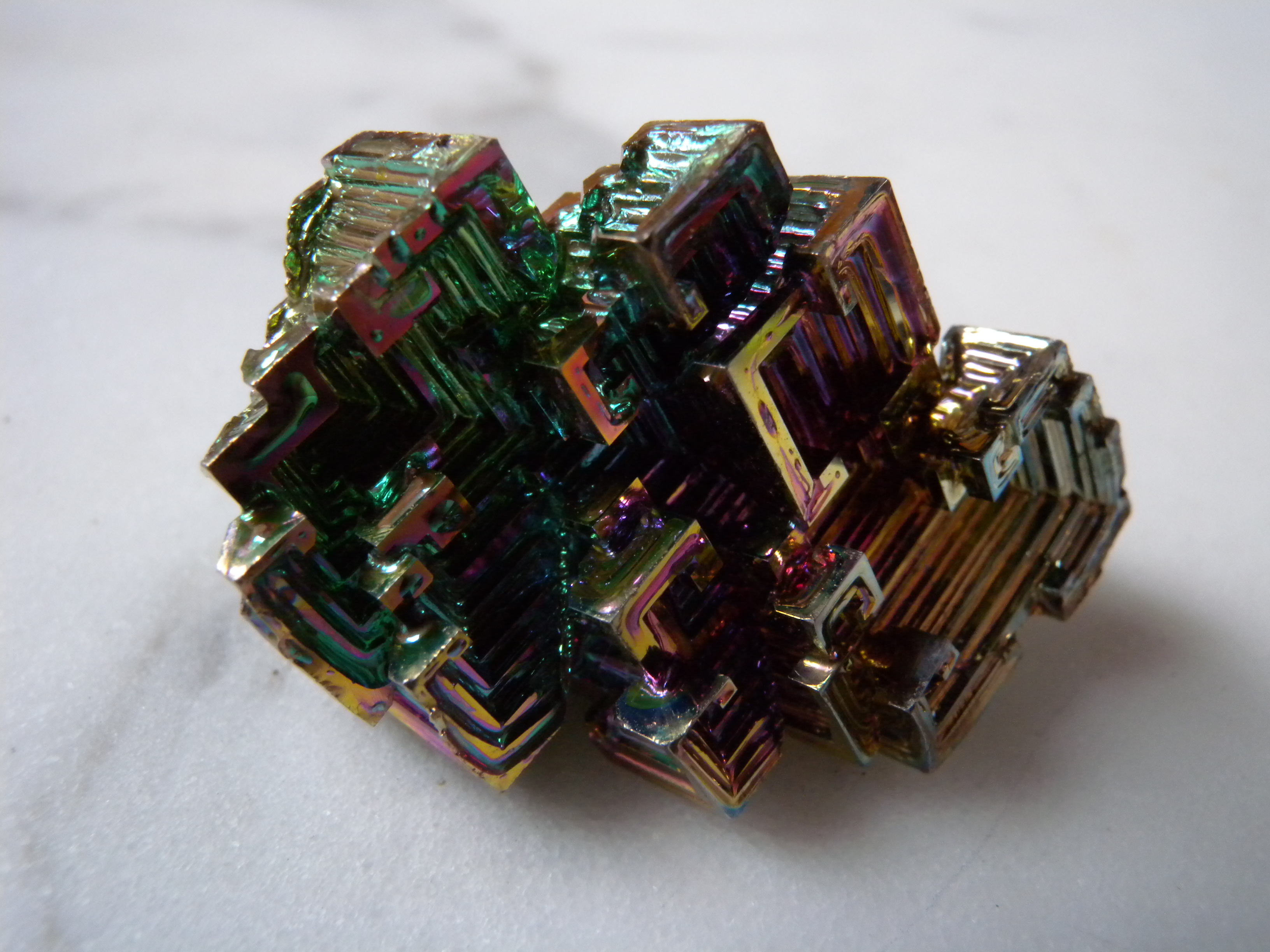
This image displays a synthetic bismuth specimen featuring intricate, stepped 'hopper' crystals with a striking iridescent tarnish that exhibits a spectrum of colors, including blue, purple, yellow, and pink.
Bismuth Physical Properties
Mohs Hardness
2.25Crystal System
trigonalLuster
metallicStreak Color
silvery-whiteCleavage
perfect on {0001}Fracture
uneven to subconchoidalSpecific Gravity
9.78Colors
silvery-white, pinkish, iridescent (yellow, blue, green, pink, purple)Transparency
opaqueType Locality
Bolivia, Australia, Germany, China, Russia (for natural occurrences)Mineral Group
Native ElementsUses
alloys, pharmaceuticals, cosmetics, pigments, collector specimensAssociated Minerals
quartz, calcite, arsenopyrite, galena, pyrite, native gold, native silverRarity
uncommonGeological Context
Native bismuth occurs in hydrothermal veins, pegmatites, and contact metamorphic deposits. The distinctive hopper crystals shown are typically synthetic, formed by cooling ultrapure bismuth from a melt, allowing for the formation of a thin oxide layer that creates interference colors.


