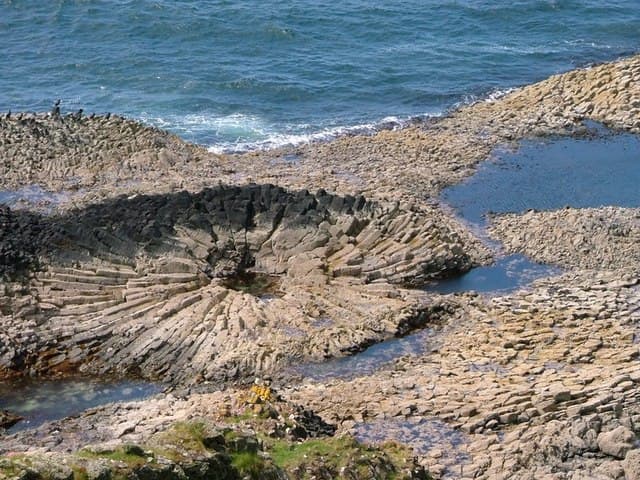
Basalt
Image: Mick Garratt (CC BY-SA 2.0)
Mineral NameBasalt
Chemical FormulaComplex silicate, rich in Fe, Mg, Ca, with minor Na, K, and Ti
Mohs Hardness5
Streak ColorGrayish-white to light gray
CleavageNone (as a rock)
FractureConchoidal to uneven
Specific Gravity2.9
Colorsdark gray, black, greenish-black, brown, tan
TransparencyOpaque
Type LocalityBunessan, Isle of Mull, Scotland (Mull Lava Group)
Mineral GroupIgneous Rock (Mafic Volcanic Rock)
Usesconstruction aggregate, road base, dimension stone, insulation
Associated Mineralsplagioclase feldspar, pyroxene (augite), olivine, magnetite
Raritycommon
Description
The image displays a coastal basalt formation with prominent columnar jointing, forming a distinctive rosette pattern on the beach, with colors ranging from dark gray to weathered light brown and tan.
Geological Context
Basalt is an extrusive igneous rock formed from the rapid cooling of mafic lava, typically associated with volcanic eruptions, oceanic crust formation, and large igneous provinces. The rosette pattern seen here is a specific type of columnar jointing formed by the cooling of lava around a central point, possibly a standing tree as described in the metadata, within the Palaeocene Mull Lava Group.


