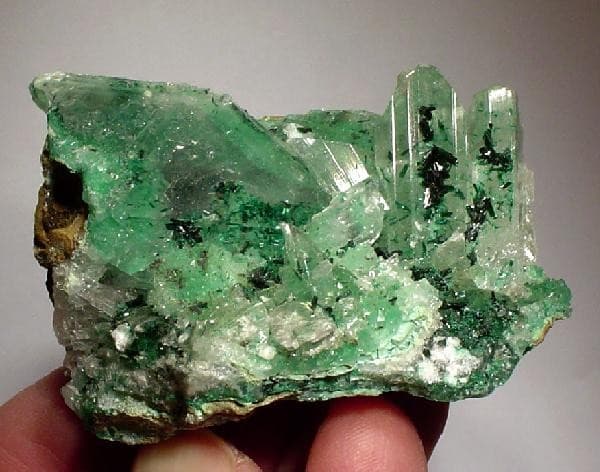
Atacamite with Gypsum
Image: Robert M. Lavinsky (CC BY-SA 3.0)
Mineral NameAtacamite with Gypsum
Chemical FormulaAtacamite: Cu2Cl(OH)3; Gypsum: CaSO4·2H2O
Mohs HardnessAtacamite: 3-3.5; Gypsum: 2
Streak ColorAtacamite: Apple-green; Gypsum: White
CleavageAtacamite: Perfect on {100}; Gypsum: Perfect on {010}
FractureAtacamite: Conchoidal to uneven; Gypsum: Conchoidal, splintery
Specific GravityAtacamite: 3.75-3.77; Gypsum: 2.31-2.32
Colorsemerald-green, dark green, colorless, white
Transparencytransparent to translucent
Type LocalityLily Mine (Lilly Mine), Pisco Umay, Ica Department, Peru
Mineral GroupHalides (Atacamite), Sulfates (Gypsum)
Usescollector, minor copper ore, industrial (gypsum)
Associated MineralsSelenite
Rarityuncommon
Description
This specimen features vibrant emerald-green, prismatic to acicular crystals of Atacamite, often forming aggregates, intergrown with clear to white, tabular crystals of Gypsum (Selenite) on a matrix.
Geological Context
Atacamite forms as a secondary mineral in the oxidized zones of copper deposits, particularly in arid regions. Gypsum is a common evaporite mineral, often found in sedimentary environments or as a secondary mineral in hydrothermal veins, here likely associated with the copper mineralization.


