Agate
Image: Hannes Grobe (CC BY-SA 2.5)
Mineral NameAgate
Chemical FormulaSiO2
Mohs Hardness7
Crystal Systemtrigonal
Lustervitreous
Streak Colorwhite
Cleavagenone
Fractureconchoidal
Specific Gravity2.65
Colorswhite, grey, brown, colorless
Transparencytranslucent
Type LocalityWorldwide, notable localities include Brazil, Uruguay, Mexico, and the United States.
Mineral GroupSilicates
Usesjewelry, ornamental objects, collector, industrial (e.g., mortars and pestles, precision bearings)
Associated Mineralsquartz, calcite, zeolites
Raritycommon
Description
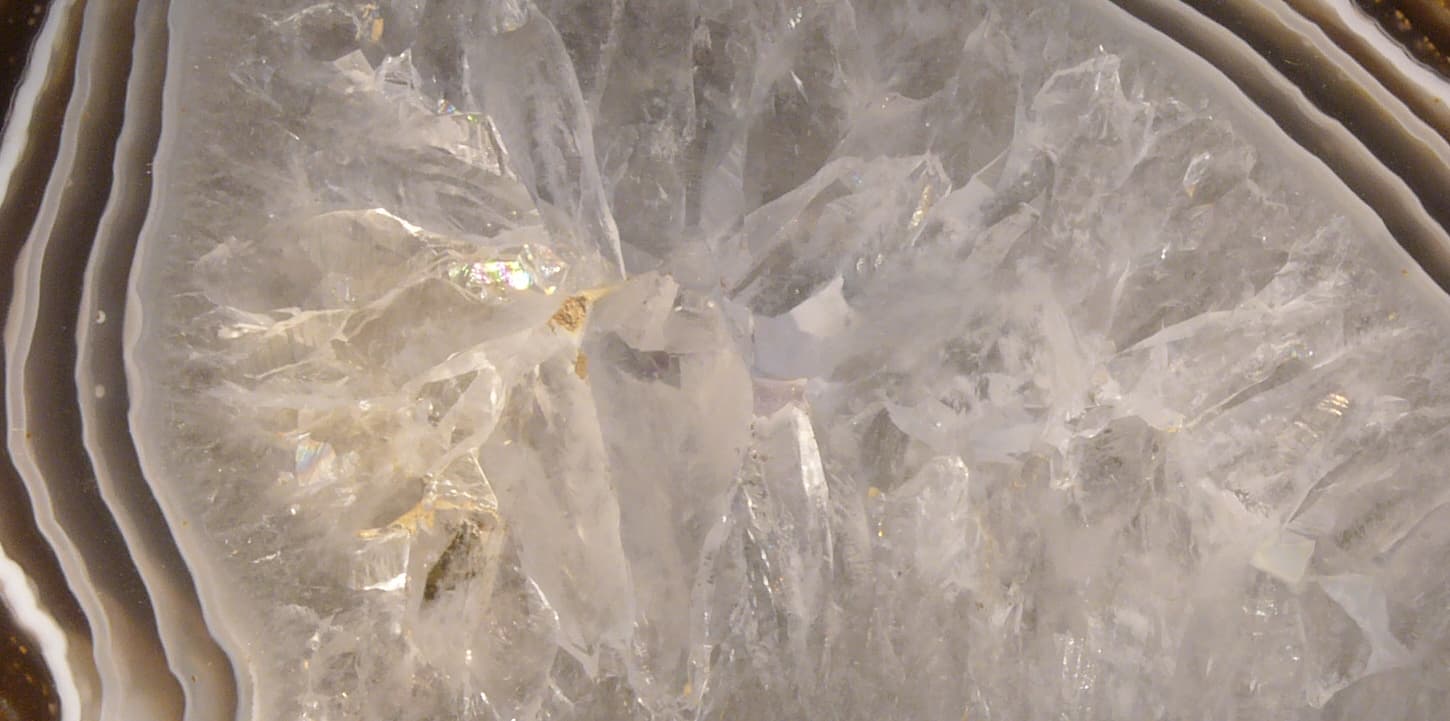
This image displays a cross-section of an agate geode, featuring distinct banded layers of chalcedony on the outer rim, transitioning into a central cavity filled with clear to milky, well-formed quartz crystals.
Geological Context
Agate typically forms in cavities of volcanic rocks (like basalt) or sometimes in sedimentary rocks. Silica-rich fluids seep into these voids, depositing successive layers of microcrystalline quartz (chalcedony) and macrocrystalline quartz over time, often creating the characteristic banding.