Agate
Image: Veronika Ronkos (CC BY-SA 3.0)
Mineral NameAgate
Chemical FormulaSiO2
Mohs Hardness7
Crystal Systemtrigonal
Lustervitreous
Streak Colorwhite
Cleavagenone
Fractureconchoidal
Specific Gravity2.65
Colorsred, orange, yellow, purple, white, translucent
Transparencytranslucent
Type LocalityBrazil, Uruguay, Mexico, USA (Oregon, Montana)
Mineral GroupSilicates
Usesjewelry, ornamental objects, collector, industrial (abrasives, precision bearings)
Associated Mineralsquartz, calcite, zeolites
Raritycommon
Description
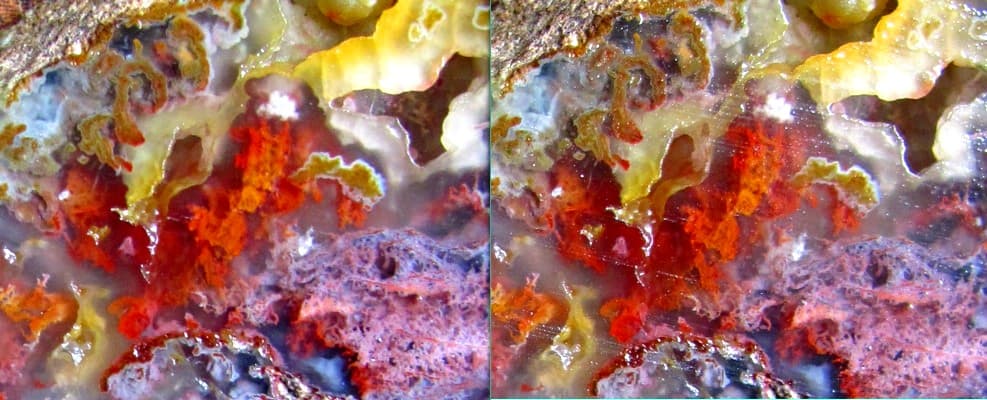
This macro image of an agate slab reveals intricate, swirling patterns with vibrant colors including deep reds, oranges, yellows, and purples, set within translucent to opaque layers. The texture appears somewhat botryoidal or stalactitic in places, suggesting a complex growth history.
Geological Context
Agate forms primarily in the vesicles of volcanic rocks or ancient lavas, where silica-rich fluids deposit layers of chalcedony, often with varying impurities that create its characteristic banding and colors. It can also be found in sedimentary rocks.