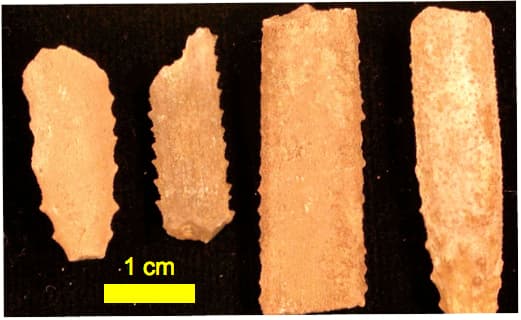
Sea Urchin Fossil
Image: Wooster09 (Public domain)
Mineral NameSea Urchin Fossil
Chemical FormulaCaCO3
Mohs Hardness3
Crystal Systemtrigonal
Lusterdull
Streak Colorwhite
Cleavageperfect rhombohedral
Fractureuneven
Specific Gravity2.71
Colorslight brown, tan, off-white
Transparencyopaque
Type LocalityMatmor Formation, Hamakhtesh Hagadol, Israel
Mineral GroupCarbonates
Usescollector, scientific study
Associated Mineralslimestone, shale, sandstone, other marine fossils
Rarityuncommon
Description
The image displays four elongated, light brown to tan fossilized sea urchin spines, varying in shape from somewhat flat to more cylindrical, with some showing serrated edges and textured surfaces.
Geological Context
These fossils formed from the calcium carbonate skeletons of ancient sea urchins in marine environments, subsequently preserved within sedimentary rock layers like the Jurassic Matmor Formation.


