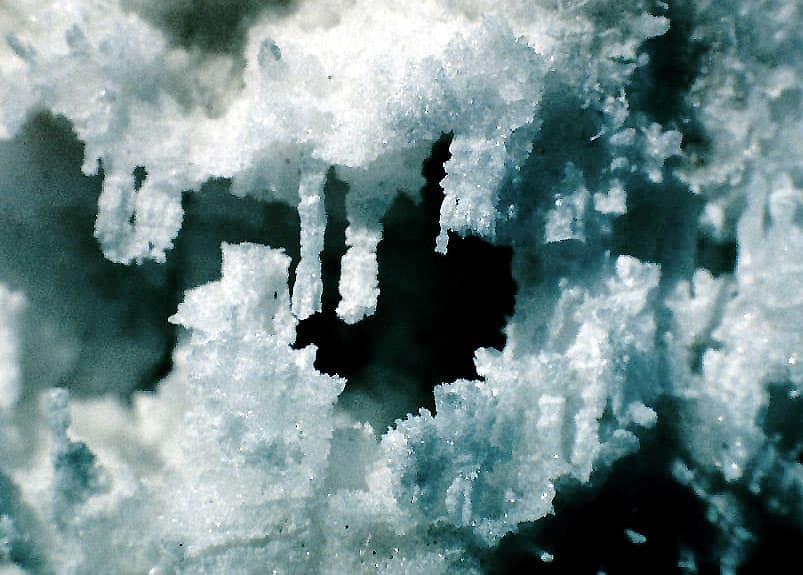
Halite
Image: LBM1948 (CC BY-SA 4.0)
Mineral NameHalite
Chemical FormulaNaCl
Mohs Hardness2.5
Crystal Systemcubic
Lustervitreous
Streak Colorwhite
Cleavageperfect cubic on {001}
Fractureconchoidal
Specific Gravity2.16
Colorswhite, colorless, gray, yellow, orange, blue, purple, pink, red
Transparencytransparent
Type LocalityBadwater Salt Flats, Death Valley National Park, California, USA
Mineral GroupHalides
Usesfood additive, de-icing roads, chemical industry, water softening, animal feed, preservative
Associated Mineralsgypsum, anhydrite, sylvite, carnallite
Raritycommon
Description
The image displays a close-up of crystallized salt, appearing as white to light blueish-white granular masses with some delicate, elongated crystal formations. The texture is rough and crystalline, typical of evaporite deposits.
Geological Context
Halite forms as an evaporite mineral in arid environments where saline water bodies, such as lakes or seas, undergo intense evaporation. It precipitates from supersaturated brines, often forming extensive beds in playas, salt flats, and ancient sedimentary basins.


