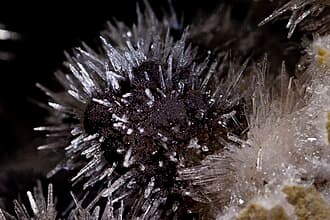
Garnet
Image: James St. John (CC BY 2.0)
Mineral NameGarnet
Chemical FormulaX3Y2(SiO4)3 (where X=Ca, Mg, Fe2+, Mn2+; Y=Al, Fe3+, Cr3+)
Mohs Hardness7
Crystal Systemcubic
Lustervitreous
Streak Colorwhite
Cleavagenone
Fractureconchoidal
Specific Gravity3.1
Colorsred, orange, yellow, green, purple, brown, black, pink, colorless
Transparencytransparent
Type LocalityGarnet Ledge, Wrangell, southeastern Alaska, USA
Mineral Groupsilicates
Usesjewelry, abrasives, waterjet cutting, filtration media
Associated Mineralsmica, quartz, feldspar, staurolite, kyanite, andalusite
Raritycommon
Description
Garnet typically forms distinct, often dodecahedral or trapezohedral crystals, commonly red, with a vitreous luster. In the provided image, it appears as dark red, rounded to subhedral crystals embedded within a foliated metamorphic matrix.
Geological Context
Garnets are common metamorphic minerals, forming under high pressure and temperature conditions during regional or contact metamorphism of various rock types, including shales, limestones, and basalts. The sample is from a schist, indicating formation during regional metamorphism.