Diorite
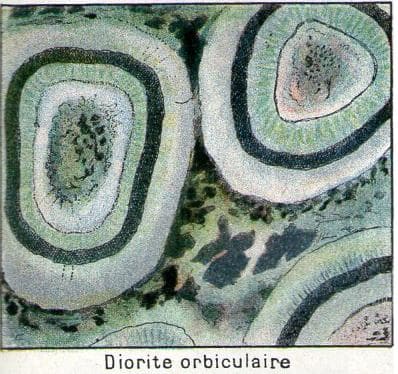
Image: Claude Augé (Public domain)
Mineral NameDiorite
Chemical FormulaPrimarily composed of plagioclase feldspar ((Na,Ca)(Al,Si)AlSi2O8) and hornblende (Ca2(Mg,Fe)4Al(Si7Al)O22(OH)2) or pyroxene. No single formula for the rock.
Mohs Hardness6
Streak ColorWhite to grayish (variable depending on mineral composition)
CleavageNot applicable for a rock; constituent minerals exhibit good cleavage (e.g., plagioclase: 2 directions at ~90°, hornblende: 2 directions at ~56° and ~124°).
FractureUneven to conchoidal (for individual minerals), generally uneven for the rock.
Specific Gravity2.85
Colorsdark gray, black, white, light green
TransparencyOpaque
Type LocalityFound worldwide in continental crust, often associated with subduction zones and mountain building, e.g., Andes, Sierra Nevada.
Mineral GroupIgneous rock (plutonic, intermediate)
Usesconstruction material, dimension stone, decorative stone, monuments
Associated Mineralsplagioclase feldspar, hornblende, biotite, pyroxene, quartz, magnetite, apatite
Description
The image displays an orbicular diorite, characterized by distinctive concentric layers of light and dark minerals forming spherical or ellipsoidal structures within a coarser-grained matrix. The colors in the image are muted greens, grays, and dark bands.
Geological Context
Diorite is an intrusive igneous rock that forms from the slow crystallization of magma deep beneath the Earth's surface. It is intermediate in composition, typically found in batholiths and stocks associated with convergent plate boundaries. Orbicular textures are rare and form under specific conditions of crystallization and magma flow.