Image: <bdi><a href="https://www.wikidata.org/wiki/Q56247090" class="extiw" title="d:Q56247090"><span title="mineral collector and dealer">Robert M. Lavinsky</span></a></bdi> (CC BY-SA 3.0)
amorphouscommonSilicates
Chrysocolla
(Cu,Al)2H2Si2O5(OH)4·nH2O
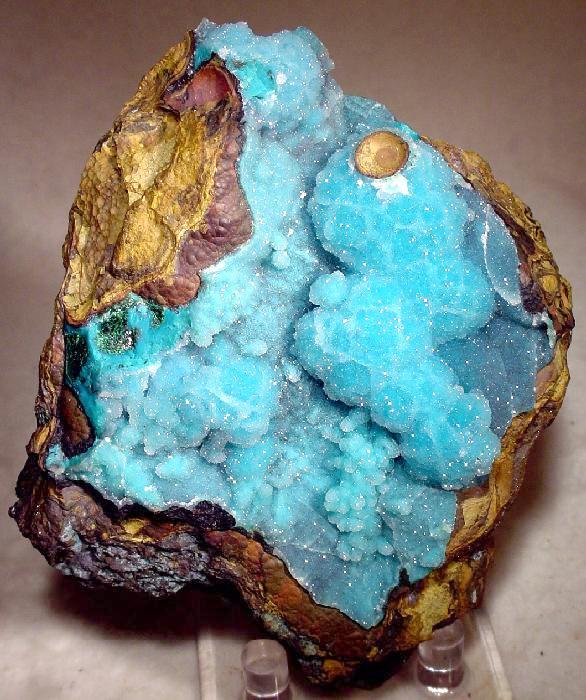
This specimen features vibrant blue-green botryoidal chrysocolla, partially covered by sparkling, clear quartz crystals, creating a striking contrast.
Chrysocolla Physical Properties
Mohs Hardness
3Crystal System
amorphousLuster
vitreousStreak Color
white to light blue-greenCleavage
noneFracture
conchoidal to unevenSpecific Gravity
2.2Colors
blue, blue-green, green, turquoiseTransparency
translucent to opaqueType Locality
Manto Tres Gracias Mine, Diego de Almagro, Chañaral Province, Atacama Region, ChileMineral Group
SilicatesUses
gemstone, ornamental stone, collector's mineral, minor copper oreAssociated Minerals
quartz, malachite, azurite, cupriteRarity
commonGeological Context
Chrysocolla is a secondary mineral that forms in the oxidation zones of copper ore deposits, typically in arid climates, precipitating from copper-rich solutions.