Azurite, Chrysocolla, and Malachite
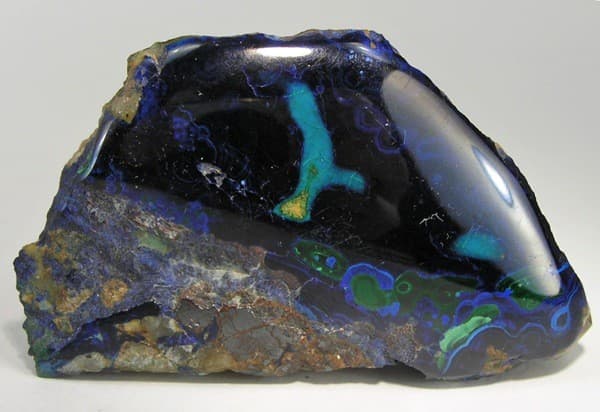
Image: Robert M. Lavinsky (CC BY-SA 3.0)
Mineral NameAzurite, Chrysocolla, and Malachite
Chemical FormulaAzurite: Cu₃(CO₃)₂(OH)₂; Chrysocolla: (Cu,Al)₂H₂Si₂O₅(OH)₄·nH₂O; Malachite: Cu₂(CO₃)(OH)₂
Mohs Hardness2.5
Streak ColorLight blue (azurite), light green (malachite), white to light blue-green (chrysocolla)
CleavageAzurite: Good on {011}; Malachite: Perfect on {201}, good on {010}; Chrysocolla: None
FractureConchoidal to uneven
Specific Gravity1.9
Colorsdeep blue, sky blue, turquoise, green, dark green
TransparencyTranslucent to opaque
Type LocalityBisbee, Arizona, USA
Mineral GroupCarbonates (Azurite, Malachite), Silicates (Chrysocolla)
Usesjewelry, ornamental stone, collector's specimens, minor copper ore
Associated Mineralscuprite, native copper, limonite, quartz
Rarityuncommon
Description
This specimen features a polished surface revealing vibrant deep blue azurite, sky blue to turquoise chrysocolla, and banded green malachite, often intergrown in botryoidal or concentric patterns. The unpolished edges show a rougher texture with mixed colors.
Geological Context
These are secondary copper minerals formed in the oxidized zones of copper ore deposits, typically found in arid regions where groundwater interacts with primary copper sulfides, leading to their precipitation.